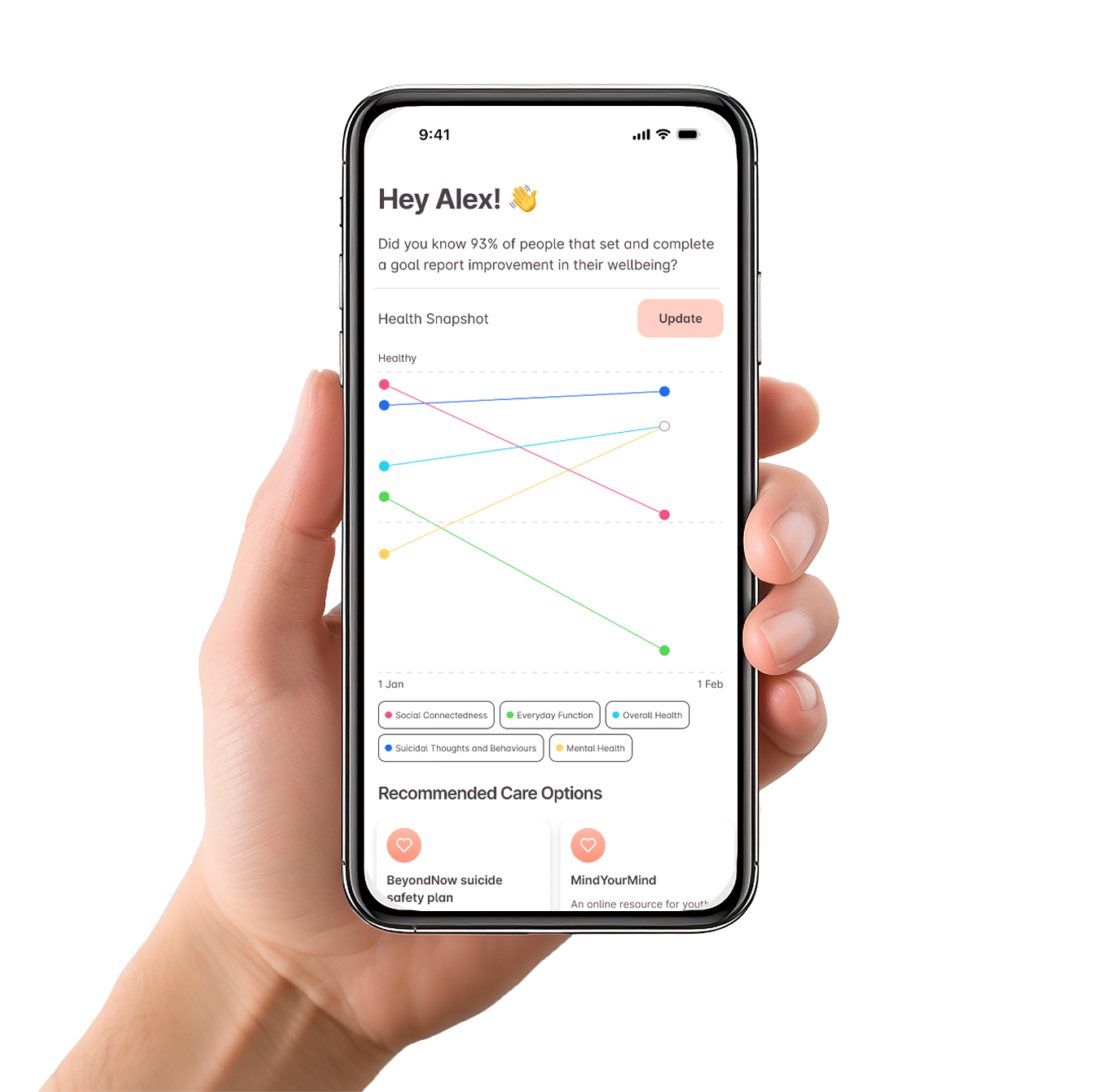
Assessments translate client experiences into measurable, trackable clinical data. Built on 15 years of University of Sydney Brain and Mind Centre research — validated, multidimensional, and designed for continuous measurement-based care.

Risk response time after SIDAS escalation
Validated assessments from 15 years of University of Sydney Brain and Mind Centre research
Five domains: Mental Health, Everyday Function, Suicidal Thoughts, Social Connectedness, Overall Health
Built for continuous MBC, not one-off screening
Assessments are structured, validated tools that measure specific dimensions of mental health and functioning. They produce comparable scores over time, enabling clinicians to track improvement or decline with clinical objectivity. They are decision-support instruments — they inform but don't replace clinical judgment, and don't diagnose.
Establish an intake baseline
Track change across sessions
Identify elevated-risk clients
Inform care planning
Demonstrate outcomes to funders and governance
MBC uses client data throughout treatment, reducing deterioration and facilitating dynamic, responsive changes to treatment plans.
The dependence of MBC on these validated assessments is driven by several critical clinical and systemic requirements:
01
Validated tools like the K10+ reduce clinician bias and variability across practitioners and services. Standardised scoring removes subjectivity from outcome tracking, producing consistent, comparable data that holds up across reviews, audits, and changes in treating clinician.
02
Innowell's algorithms stratify clients from Stage 1a through Stage 2+, achieving 91% concordance with expert psychiatrists. Staging enables earlier intervention, more targeted care planning, and a shared clinical language across multidisciplinary teams.
03
SIDAS triggers automated alerts when suicidal ideation scores exceed clinical thresholds. With a median clinician response time of 1.9 days, Innowell catches deterioration before it becomes crisis — without requiring manual monitoring of every client record.
04
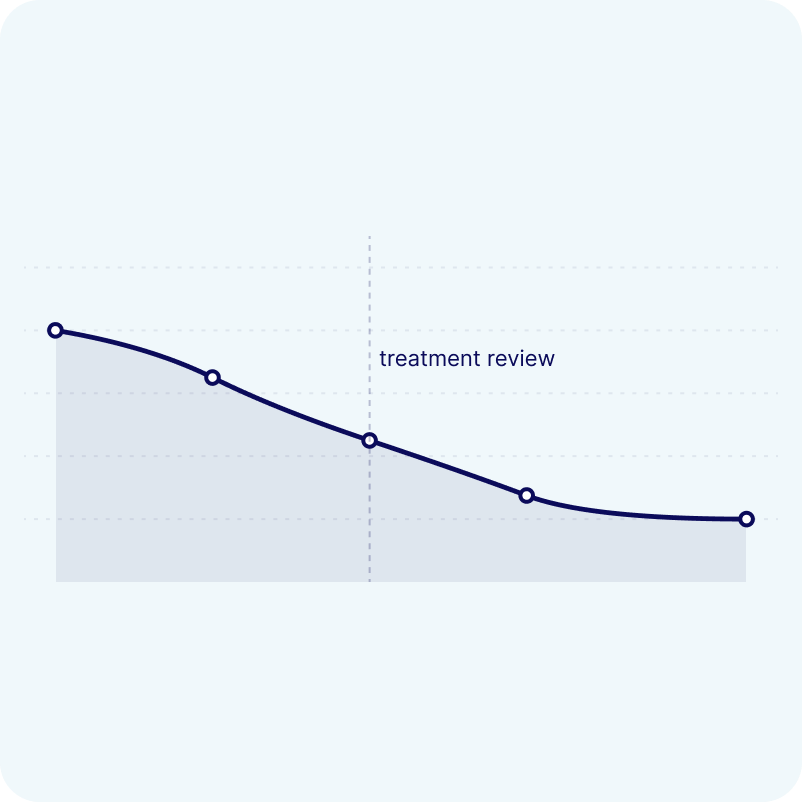
Repeated assessments visualise client trajectories across weeks, months, and years. Rather than relying on recall or static snapshots, clinicians can see trend lines that reveal whether a treatment plan is working — and adjust proactively before a client deteriorates.
05
When clients and clinicians look at the same outcome data together, the therapeutic relationship shifts. A shared clinical language helps clients conceptualise their own symptoms, understand progress, and engage more meaningfully in decisions about their care.
06
Aggregated de-identified data produces a Service Needs Index, enabling health services and PHNs to understand population-level need, allocate resources based on evidence, and demonstrate outcomes to funders — without additional data collection burden on clinicians.
30 validated assessments across 5 domains
Standard care often treats assessments as one-off events — completed at intake, filed, and rarely revisited. Innowell schedules assessments at clinically appropriate intervals (typically every two weeks, with full reassessment every eight weeks), so change-over-time becomes visible rather than assumed. Trend lines replace single scores.
Rather than measuring a single condition, Innowell captures five interlocking domains simultaneously — Mental Health, Everyday Function, Suicidal Thoughts & Behaviours, Social Connectedness, and Overall Health. This produces a full clinical picture, not a one-dimensional score.
Branching question logic means clients are only asked what is relevant to their current presentation. If a client's initial responses indicate low risk in a domain, follow-up questions are skipped automatically — reducing burden while maintaining clinical rigour.
Both the client and clinician see the same outcome data in real time. Shared graphs turn abstract scores into a meaningful conversation, supporting genuine shared decision-making and increasing client engagement with their own care.
When SIDAS scores exceed clinical thresholds, Innowell sends automated alerts to the treating team — without requiring manual chart review. The median clinical response time is 1.9 days, catching deterioration before it becomes crisis.
Assessment data flows automatically into structured clinical reports, audit trails, and outcomes dashboards. This eliminates double-handling of data and makes demonstrating compliance with accreditation standards significantly less burdensome for services.
Innowell was co-developed with the University of Sydney's Brain and Mind Centre, one of the most cited mental health research institutions in the Asia-Pacific region. The platform's clinical model, including its multidimensional assessment framework and use of clinical staging, is grounded in more than 72 peer-reviewed publications.
Purpose-built to meet PHN and health service reporting requirements, with aggregate insights that support governance and funding submissions.
Designed to reduce clinician documentation burden while amplifying clinical insight — so you spend more time on care and less time on admin.
The K10 is a 10-item scale measuring psychological distress over the past four weeks. The K10+ used in Innowell extends this with additional items covering suicidal ideation, substance use, and functional impairment — giving clinicians a richer baseline and enabling clinical staging. Both are validated and widely used in Australian mental health services, but the K10+ provides the multidimensional data needed for Innowell's outcome tracking and escalation logic.
Innowell recommends a brief check-in assessment every two weeks, with a full multidimensional reassessment every eight weeks. These intervals are based on clinical research from the Brain and Mind Centre and are designed to capture meaningful change over time without adding significant burden to clients or clinicians. Services can configure intervals to suit their model of care.
No. Innowell assessments are decision-support instruments — they measure and track clinical dimensions, not diagnose. They produce validated, comparable scores across mental health, functioning, suicidal ideation, social connectedness, and overall health. All clinical interpretation and diagnosis remains the responsibility of the treating clinician. Assessment data informs but never replaces clinical judgment.
Yes. Innowell includes validated child-appropriate assessments such as the SCARED (Screen for Child Anxiety Related Disorders) for clients under 18. The platform supports age-appropriate branching logic and language, and services working with younger populations can configure which assessment sets are available based on their cohort. Parent or carer proxy reporting is also supported for younger age groups.
Innowell's library includes 30 validated assessments across five domains, and services can configure which are active for their context. Adding entirely custom, service-specific assessments is available via the enterprise configuration pathway. Innowell's clinical team works with services to evaluate whether proposed instruments meet the validation standards required for clinical use within the platform. Contact your implementation manager to discuss this.
Scoring is automated and happens in real time as clients complete assessments. Each instrument uses its validated scoring algorithm — for example, the K10+ produces a total distress score with established cut-off thresholds, while SIDAS scores trigger risk escalation alerts above specific values. Scores are immediately visible to the treating clinician on their dashboard, alongside trend lines across previous assessments.
Innowell supports integration with major Australian EMR and clinical information systems via HL7 FHIR-compliant APIs. Current integrations include Heidi Health for clinical documentation, and the platform is actively expanding its integration ecosystem. Your implementation team will assess your existing system landscape during onboarding and identify the right integration approach for your service.